
Home/Mold Testing/Clarksburg, MD

Mold testing

Mold Testing in Clarksburg, MD

Samples taken in your home, analysed by an accredited laboratory. We do not sell remediation, so the report has nothing to sell you.

4.9 rating, over 4,000 reviews NAMRI-certified inspectors Serving Montgomery County

Schedule a mold test Call (703) 450-6398

How much does mold testing cost in Clarksburg?

Four options, depending on how much of the home you need looked at. Not sure which one fits? Start with the thirty minute visit and a technician will tell you what is actually worth testing. Decide to test while they are there and the visit is written up as a Mold Plus.

No sampling

Mold Walk & Talk

"Something feels off and I do not know if testing is worth it."

$175

30 minutes on site

  • Time with an environmental technician
  • Moisture meter and thermal camera
  • Findings explained on the spot
  • Each additional 30 minutes $95
  • No samples or laboratory work

One area, tested

Mold Basic

"I can see it, or I know exactly where to look."

$345

One targeted area, 1 to 2 hours

  • Indoor sample plus outdoor comparison
  • Accredited laboratory analysis
  • Written laboratory report
  • Additional samples $95 each

One area, plus the source

Mold Plus

"There was a leak and I want to know where the water went."

$495

One targeted area, 1 to 2 hours

  • Everything in Mold Basic
  • Moisture and thermal evaluation of the area
  • Read Your Mold Report guide
  • Each additional area $50 plus its $95 sample

The whole home

Mold Advanced

"It could be anywhere, or it keeps coming back."

From $550

Priced by home size, 1 to 2 hours

  • Whole home moisture and thermal evaluation
  • Sampling in the areas that call for it
  • Read Your Mold Report guide
  • Post-remediation re-test $295 held 3 months

* Prices shown are for Virginia and Maryland. In Washington DC, Mold Basic is $425, Mold Plus is $575, and Mold Advanced starts at $630, with $80 added to every home-size tier. Mold Walk & Talk is $175 everywhere.

Where moisture can hide in Clarksburg homes

Montgomery Planning's history of the area places Clarksburg at the north end of the Interstate 270 corridor, about four miles north of Germantown, describing growth from a small historic settlement into a new community under a 1994 master plan. The plan set a Town Center compatible in scale with the Clarksburg Historic District along Frederick Road, while protecting the Ten Mile Creek and Little Seneca Creek valleys. That range, from an older roadside building to a freshly finished town center unit, means a damp room can trace to different construction.

For a house along Frederick Road in the historic district, identify cellar access, added rooms and how close the structure sits to the road itself. In a Clarksburg Town Center condominium or townhouse, bring window, balcony and shared-wall repair records, since a concealed connection may run through more than one unit. Toward Ten Mile Creek, Little Seneca Creek or the regional parkland at the edges of town, describe grading, well or septic details and any crawlspace access on a larger lot. Note whether the concern followed a specific storm, a nearby construction project, or a recent change in how the yard is graded.

Local background: Montgomery Planning: Clarksburg Master Plan history, Montgomery Planning: Clarksburg community page.

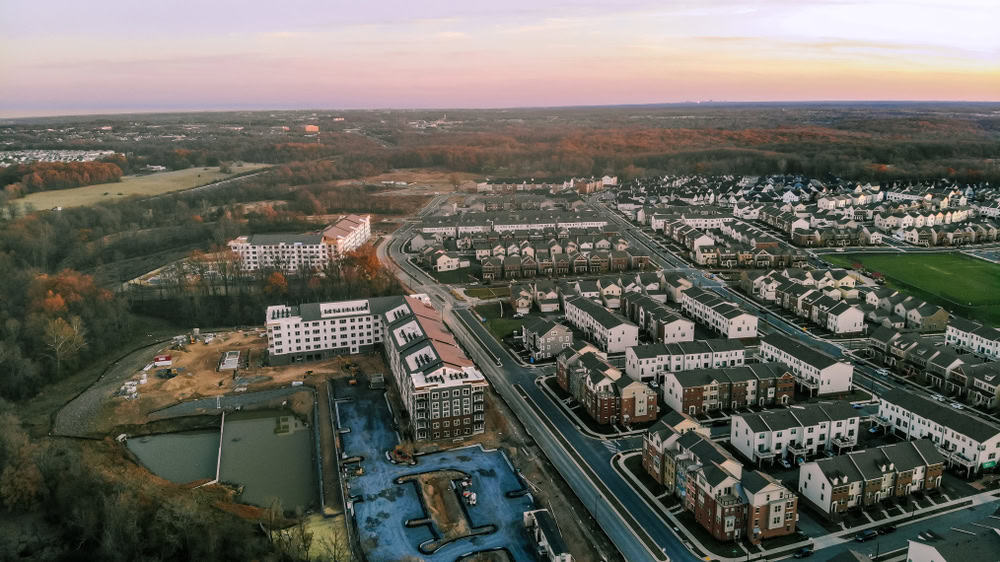
Aerial view of a new townhouse community under construction

01

Roadside houses with shallow setbacks

Frederick Road buildings sit close to the roadway with little space for grading to carry water away from the foundation. Describe how runoff moves past the house and whether a gutter or downspout was recently changed or repositioned during nearby road work.

02

Mechanical ventilation in new construction

A recently built condominium or townhouse in the Town Center relies on mechanical ventilation more than an older single-family house nearby does. Record how the unit is ventilated and whether humidity has felt noticeable since move-in, especially in bathrooms.

03

Slopes above Ten Mile Creek

A house graded toward Ten Mile Creek or Little Seneca Creek can carry stormwater differently than one graded away from a stream. Describe the slope, any recent regrading work and standing water noticed in the yard after rain.

Where we test in Clarksburg, and what to tell us

  • The Clarksburg Historic District, Frederick Road

    For an older roadside house, identify cellar or crawlspace access and any addition built onto the original structure. Describe how close the building sits to the road and where staining first appeared.

  • Clarksburg Town Center

    In a newly built condominium or townhouse, bring window, roof and shared-wall repair records. Identify the unit's exact location within the building and any recent construction work nearby, including whether a neighboring unit shares the same roofline.

  • The Ten Mile Creek and Little Seneca Creek valleys

    On a larger lot near the stream valleys or regional parkland, describe grading, well or septic details and crawlspace ground cover. Note the property's distance from the water and whether the yard has ever held standing water after a storm.

We test. We never sell you the fix.

No version of your result is worth more to us than another one. If the report says you need work, you choose the remediator. A separate post-remediation assessment can document conditions after the work within its agreed scope.

Before you book in Maryland

For a Maryland property, define the question before ordering samples: a particular stain, persistent odor, water event or follow-up after repairs. Keep dated observations and laboratory findings with the repair history. A report does not determine health risks, insurance coverage or legal responsibility. Montgomery County also publishes separate radon requirements for covered home sales; confirm which rules apply to your transaction.

EPA sampling guidance; Montgomery County radon guidance. Current as of September 2026. General information, not legal advice.

Mold testing in Clarksburg, answered straight

Which service fits a stain in my Clarksburg Town Center condo?

Describe whether the mark is confined to one wall or ceiling area. A Walk & Talk visit is a consultation with no laboratory component, Mold Basic narrows in on that single area, and Mold Plus layers in a moisture and thermal evaluation of it. Call ahead and describe what you have seen so the visit can be scoped appropriately.

Is a brand-new Clarksburg townhouse worth testing at all?

A recent completion date does not rule out a concealed leak or a construction-related moisture issue. Describe any builder repairs, punch-list items or odors noticed since move-in. The technician can evaluate the specific area you describe rather than simply assuming new construction is automatically dry, particularly around windows and roof penetrations.

Can a Frederick Road historic house be tested without damaging its trim?

Air sampling and accessible surface sampling do not generally require removing historic trim or opening finished walls. Describe delicate finishes and any area you would rather keep untouched when booking, and the technician can explain what a non-invasive visit can and cannot address at your address before scheduling.

My lot slopes toward Little Seneca Creek. Does that affect a visit?

Tell us about the slope, any standing water after storms and whether the lower level has taken on water in the past. Site grading can influence the technician's approach to a below-grade room, but it does not by itself determine what a sample will show once the visit is complete.

Book a mold test in Clarksburg

Real availability on the next screen. No call back required.

Schedule a mold test Request a price

NextDay Inspect
46179 Westlake Dr, Ste 200, Sterling, VA 20165
(703) 450-6398

Call Schedule