


Electromagnetic Field
Testing
Find out what's actually in the room.
You can't see an electromagnetic field, and you can't judge one by looking at the room it's in. EMF testing measures the fields actually present in a building — where they come from, how strong they are, and how much of that reaches the desk you work at or the bed you sleep in. Our certified inspectors survey the property and give you readings tied to real locations, not one number for the whole house.
What is electromagnetic field testing?
EMF testing documents electric and magnetic field readings at agreed locations in your property. Readings help compare conditions near electrical sources and in the rooms you use. The source, distance, equipment operating at the time and measurement method all matter when interpreting a result. A survey documents conditions observed during the visit; it does not diagnose symptoms or establish whether a field caused a health condition.
Tell us your property address and the question you want answered so we can confirm the testing scope for your home or workplace. EMF testing is one of our environmental services. The written results provide a record of the readings and locations surveyed, rather than a guarantee that a property is free of health risk.
How electromagnetic fields are produced
Electromagnetic fields are produced by the voltage present in an electrical system. Higher voltage means a stronger electric field — which is why these four source groups behave so differently from one another.
Power Lines & Service Entry
EMF · SUPPLYIn suburban and urban areas, many people live close to overhead powerlines, which means they are exposed to strong artificial electromagnetic fields. These carry the highest voltages anywhere near a property, and the point where that supply enters the building — the meter, the service entry and the panel — is usually the single strongest location inside it.
- Overhead Power Lines
- Underground Feeds
- Meter Base
- Electrical Panel
- Service Entry
Household Appliances
EMF · APPLIANCESMicrowaves and other household appliances draw the most current in the building, so the fields around them are strongest while they are actually running. Motors and heating elements are the reason — and the field drops away just as quickly once the cycle finishes.
- Microwaves
- Refrigerators
- Washers & Dryers
- Ovens & Ranges
- Dishwashers
Electronics & Screens
EMF · ELECTRONICSCell phones, televisions and computers draw far less current than a dryer — but they are usually a great deal closer to a person, and running for far longer. Proximity and duration are what make this group worth measuring, not raw strength.
- Cell Phones
- Televisions
- Computers
- Chargers
- Wi-Fi Routers
Wiring & Power Strips
EMF · WIRINGPower strips — and any other item that carries voltage — produce a field of their own, including the wiring running inside the walls. This is the group people forget, because it is invisible: bundled cable behind a desk, a bed headboard against a wired wall, or a media console full of adapters.
- In-Wall Wiring
- Power Strips
- Extension Cords
- Junction Boxes
- Cable Runs

Everyday devices that produce electromagnetic fields
The electromagnetic spectrum
The electromagnetic spectrum shows that EMFs fall into two categories. The distinction concerns the energy of the radiation; it does not, by itself, determine whether a particular property measurement calls for action.
Where a source sits on the spectrum decides what its measurement actually means. Almost everything in a home falls on the non-ionizing side — so a number on its own tells you very little until you know which category produced it.
Non-Ionizing
LOWER ENERGYThese fields lack the energy needed to ionize atoms. They do not directly damage DNA as ionizing radiation can. Field type, frequency and intensity still matter when interpreting readings; see the National Cancer Institute fact sheet.
- Power Lines
- Household Wiring
- Appliances
- Computers & TVs
- Cell Phones
Ionizing
HIGHER ENERGYThese have harmful effects on human health and can potentially damage DNA and human cells. They carry enough energy to strip electrons from atoms — which is precisely what the household side of the spectrum cannot do.
- X-Rays
- Gamma Radiation
- Far Ultraviolet
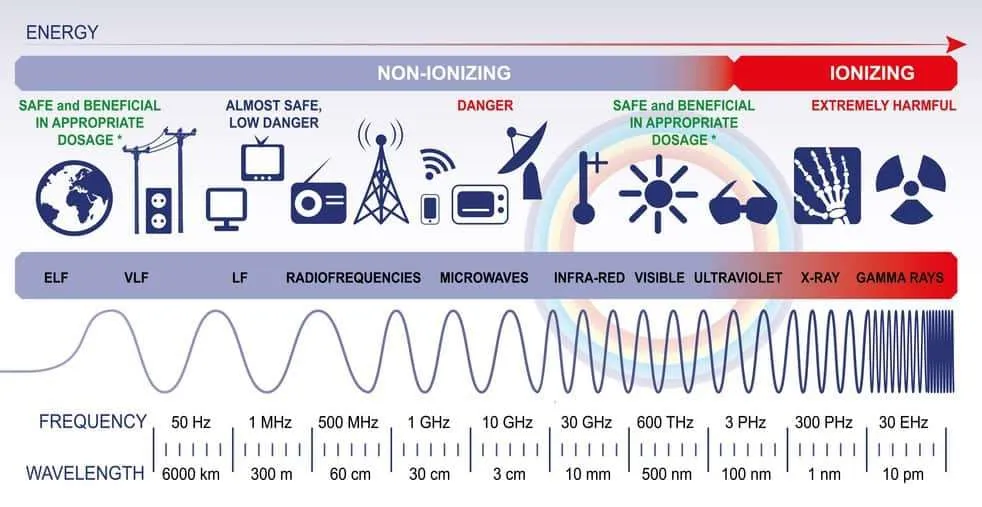
The electromagnetic spectrum, non-ionizing through ionizing
Symptoms attributed to EMF exposure
Some people report a consistent set of symptoms they associate with being around electromagnetic fields. Testing can't diagnose that — but it can tell you what is actually present where you spend your time.
Electromagnetic hypersensitivity describes symptoms people attribute to EMF exposure. The World Health Organization says evidence has not established EMF exposure as their cause. Reported symptoms vary and can have many possible causes. The examples below are not a diagnostic checklist:
- Headache
- Eye Irritation
- Dizziness
- Nausea
- Skin Rash
- Facial Swelling
- Weakness
- Fatigue
- Pain in Joints and/or Muscles
- Buzzing/Ringing in the Ears
- Skin Numbness
- Abdominal Pressure and Pain
- Breathing Difficulty
- Irregular Heartbeat
This list is informational and is not a diagnosis. Symptoms like these have many possible causes — speak with a physician about the symptoms themselves. What an EMF survey contributes is the other half of the picture: a record of what fields are actually present in the rooms you use, and where they come from.
How the survey actually runs
A useful EMF survey isn't one number for the house. It is a set of readings tied to specific sources and specific distances — because both of those change the answer.
Walk The Property
Locate what's actually producing fields: the panel and service entry, proximity to overhead or underground lines, appliance placement, and where the wiring runs relative to the rooms people use most.
Measure At The Source
Readings are taken at each identified source, with appliances measured under normal operation — a microwave that isn't running tells you nothing about a microwave that is.
Measure Where You Live
The same readings are repeated at occupied distance — at the desk, the bed, the sofa, the crib. Because field strength falls off sharply with distance, this is the number that actually describes your exposure.
Document & Review
Every reading is recorded against its location, its source and the distance it was taken from, so the results can be compared, revisited later, and acted on where it makes sense to.
Should I have EMF testing done?
There is no way to see an electromagnetic field, and no way to judge one by looking at the room it's in. A survey replaces the guess with a measurement.

Every appliance that carries voltage produces a field of its own
It is worth doing if you live close to power lines, if you are moving into a property whose electrical system you don't know, if a home office or a child's bedroom shares a wall with the panel — or simply if you'd rather know than wonder.
Most of what a result asks of you is unglamorous: moving a bed away from a wall, relocating a power strip, rearranging a desk. The value is in knowing which of those is worth doing — and which would change nothing at all.
Know what you're getting back
Get an idea of the format and the items listed in an environmental testing report before you book — then schedule your EMF testing when you're ready.