

Home/Home Inspection/Springfield, VA
Home inspection
A rambler with a crawlspace and a colonial with a finished basement get the same walkthrough in Springfield, then a report ranks what to fix first.
4.9 rating, over 4,000 reviews Licensed and insured inspectors Serving Springfield and all of Fairfax County
Every inspection covers the same 12 areas, from the roof down to the grounds, and the report is organized the same way. It is visual and non-invasive: nothing is opened up, and nothing you own is moved. Tap any area to see what is checked.
Every inspection follows a written standard of practice. Radon, termite, mold and water testing can be added to the same visit.
Three packages built around the home inspection. Package prices are for the add-on services only and are added to the inspection price. The savings are against booking the same services one by one.
The perfect starting point
Most popular for homebuyers
The ultimate peace of mind
Warranties must be requested when you book, not after the inspection. Radon and thermal imaging can also be added on their own. Read more about each package.
No jargon, no surprises. Here is the whole visit, start to finish, so you know what you are booking before you book it.

Online or by phone, in a few minutes. Your agent can book for you. Add radon, termite or a package at the same time, and we confirm the appointment with you before the visit.
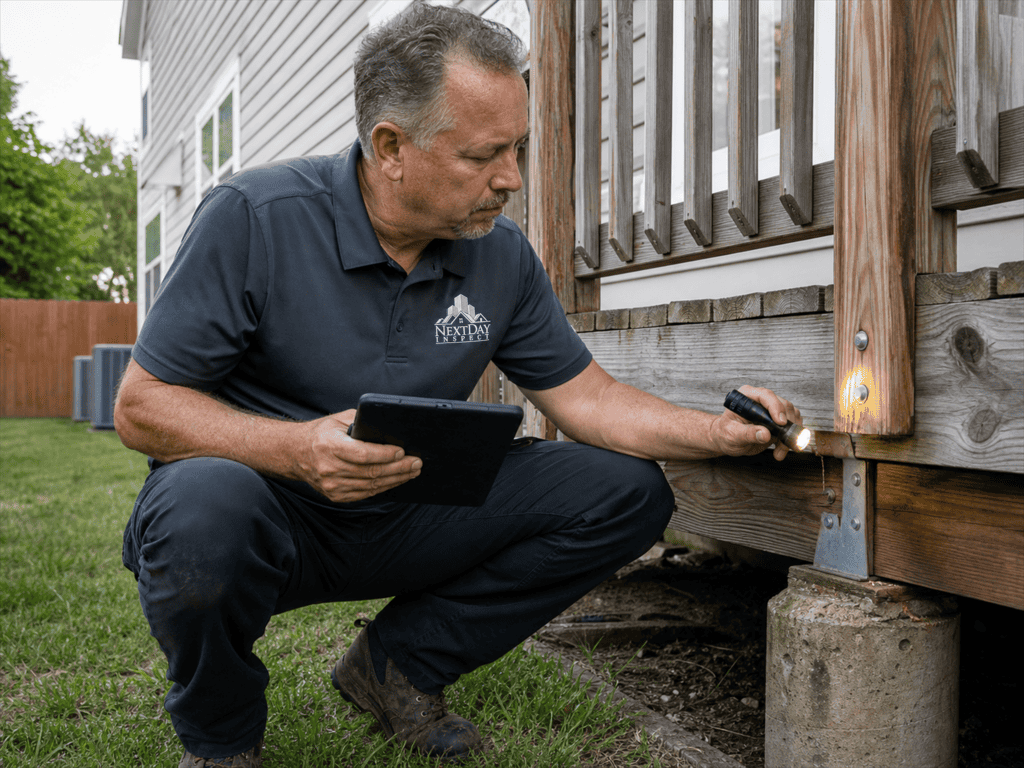
Roof, siding, grading, decks, the garage and the grounds first. The inspector photographs what they find as they go, so the report shows you exactly where each item is.

Panel cover off. Water heater, furnace and air conditioning run with their normal controls. Every fixture, every room, the attic, and the basement or crawlspace.

You see the main findings in the house itself. The written report follows online with photos, priorities and what to do about each item.
North Springfield and Springfield Estates hold much of the area's original block-foundation construction, while West Springfield and Rolling Valley carry more houses expanded with a finished basement or a rear addition. Springfield is not its own municipality, so its permit history lives with Fairfax County rather than any town office. The inspection reads a house's foundation type and construction era before anything else.
Block or masonry foundation walls can hold moisture without an obvious leak showing up inside, so the inspection reads accessible foundation and crawlspace surfaces for cracking, staining, or active water penetration rather than assuming a finish coat means everything underneath is fine. Crawlspace entrances get checked for safe, clear access, and any area that stays damp longer than the rest gets noted. Framing, the roof covering, the electrical panel, and heating and cooling on normal controls all get the same walkthrough regardless of foundation type.
Fairfax County's own homeowner guide places shrink-swell marine clay soils on steep hilly land east of Interstates 95 and 395, ground that runs through parts of Springfield and can crack a foundation wall or a slab over time.
An expanded house or a finished basement in West Springfield or Rolling Valley shows its history at the seam where the original framing meets the newer work, and the inspection follows that seam closely rather than treating the whole space as one unit. Roof lines, siding, and window ages often shift at that same junction, and the electrical panel gets checked for how later circuits were added onto the original service. Photographs from before finishes went in, if you have them, help frame what the visit is looking at.
Fairfax County Land Development Services keeps a free public Site Records Viewer and Development Tracker, letting a buyer look up when a West Springfield addition or a finished basement was actually permitted.
Springfield sits in Fairfax County, and the same inspectors cover the whole county. Every place below has its own page.
What Springfield buyers ask about permits, block walls, and additions.
No. Springfield is an unincorporated part of Fairfax County, so the county's Land Development Services issues building permits and keeps the property record for any address here. Give the full street address when you book, and the county's own Site Records Viewer can confirm what has been permitted on that specific house.
Not on its own. Block and masonry foundations are common across North Springfield and Springfield Estates, and the inspection reads accessible walls and the crawlspace for actual signs of cracking or water penetration rather than assuming a problem from the construction type alone. The report reflects what is observed on the day of the visit.
Most of Springfield is, and the inspection runs the same plumbing checks either way: fixtures run for drainage, the water heater and its venting, and visible supply and drain lines. It does not test water quality, flow rate, or a private well or septic system. Mention any private system at your specific address when you book.
It is worth considering, since Fairfax County sits in the EPA's highest radon potential category countywide. A standard home inspection does not test for radon on its own, as that falls outside its scope, but radon testing can be added to the same visit as its own separate service and reports its own result.
Yes. The walkthrough near the end of the visit is when the inspector covers the roof, attic, crawlspace or basement, and every major system in person, and your agent is welcome to attend in your place. The full written report follows online afterward regardless of who was there for the walkthrough itself.