

Home/Home Inspection/Prince George's County, MD
Home inspection
A licensed inspector opens the panel, runs every fixture, and climbs into the attic, then sends a photo report that puts priorities on what you saw during the walkthrough.
4.9 rating, over 4,000 reviews Licensed and insured inspectors Serving all of Prince George's County
Prince George's County built outward from the District line, from Chillum and Landover through College Park and Greenbelt to Bowie, Laurel, Clinton, and Fort Washington, and one team covers every community listed here.
Brick duplexes and postwar garden apartments sit on tight lots just inside the District line, built up over several different decades.
Older farmhouses and brick foursquares sit near postwar duplexes and garden apartments crowded against newer commercial development along the Beltway.
Frame cottages from the original crossroads sit near brick garden apartments built up around the federal government's midcentury expansion.
Campus rentals near the university share streets with older bungalows and later brick houses built during the college town's biggest growth years.
Cooperative rowhouses from the town's earliest section sit near garden apartments and newer condominium towers closer to the Metro station.
Older farmhouses on well and septic near the original crossroads sit close to newer subdivisions built out along Woodyard Road.
Walkout lower levels above the golf course sit near older farmhouses close to the creek and newer construction closer to the Beltway.
Bowie, College Park, Greenbelt, and Laurel are incorporated cities inside the county; Chillum, Clinton, Fort Washington, Landover, and Suitland are unincorporated communities known by their postal names.
Three packages built around the home inspection. Package prices are for the add-on services only and are added to the inspection price. The savings are against booking the same services one by one.
The perfect starting point
Most popular for homebuyers
The ultimate peace of mind
Warranties must be requested when you book, not after the inspection. Radon and thermal imaging can also be added on their own. Read more about each package.
No jargon, no surprises. Here is the whole visit, start to finish, so you know what you are booking before you book it.

Online or by phone, in a few minutes. Your agent can book for you. Add radon, termite or a package at the same time, and we confirm the appointment with you before the visit.
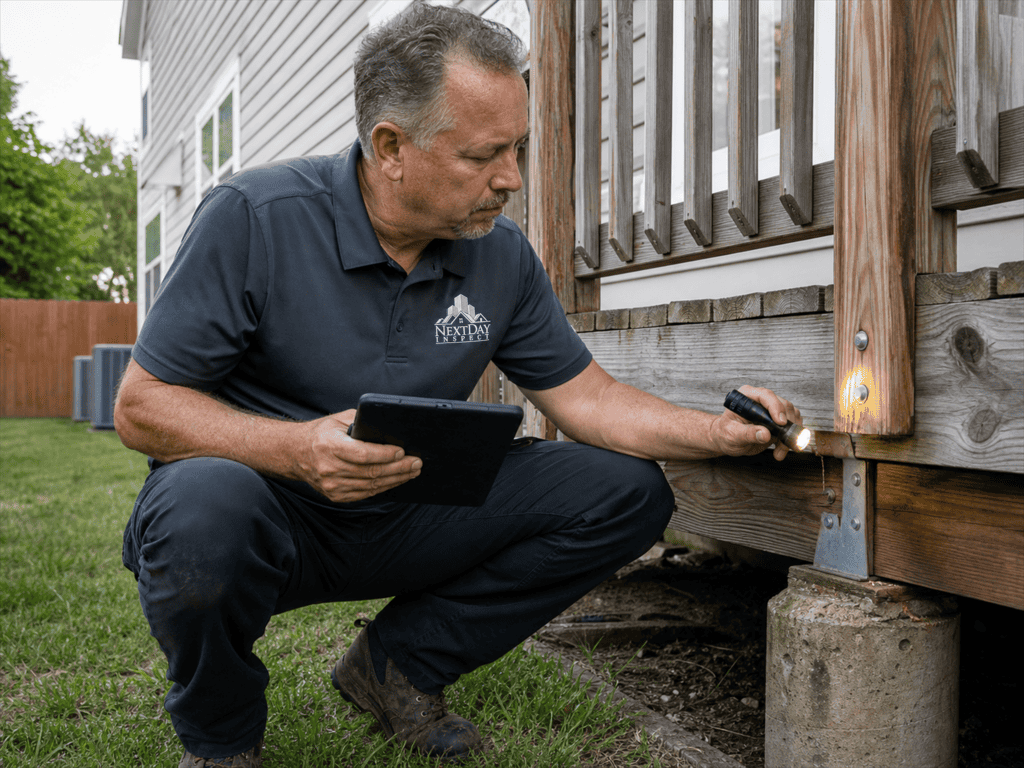
Roof, siding, grading, decks, the garage and the grounds first. The inspector photographs what they find as they go, so the report shows you exactly where each item is.

Panel cover off. Water heater, furnace and air conditioning run with their normal controls. Every fixture, every room, the attic, and the basement or crawlspace.

You see the main findings in the house itself. The written report follows online with photos, priorities and what to do about each item.
Prince George's County built outward from the District line. Chillum, Landover, and Suitland filled in first, followed by the university town of College Park and the planned community of Greenbelt. Bowie and Laurel grew up around older rail and mill settlements before spreading into newer subdivisions, while Clinton and Fort Washington, toward the county's southern reach, still mix old farm crossroads with newer construction.
Chillum, Landover, and Suitland filled in early, and their older sections carry brick duplexes and garden apartment buildings built up in layers over several decades, many of them rented rather than owner-occupied. The inspection follows the same scope whether a unit is owned or rented: the foundation and any crawlspace for water penetration, the electrical panel and a sample of outlets and switches, the plumbing fixtures run for drainage, and the heating and cooling systems tested on their normal controls. In a duplex or a small multi-unit building, each unit is inspected on its own, alongside the shared roof and any common electrical service.
Maryland law requires any rental unit built before 1978 to be registered with the state within 30 days of a new owner acquiring it, a rule that reaches much of the older rental stock inside the Beltway.
The county's own soil conservation guidance groups the Christiana soil complexes and the Marlboro Clay formation among the ground with the most severe limitations for foundation work, and warns that water left standing on that clay can speed a slope failure. That ground runs through many parts of the county, not one corner of it, so the inspection pays close attention to the grading beside the foundation and whether a sump pit has kept up during heavy rain. In a rambler or a rowhouse with a finished basement, the crawlspace or the slab gets the same look for cracking, moisture, and how the framing is holding up.
Prince George's County's DPIE portal includes a Permit History by Street Address search, letting a buyer look up what was permitted on a specific rambler, rowhouse, or townhouse before making an offer.
Prince George's County is one of 11 Maryland counties we cover, and the same inspectors work all of them. Every county below has its own page.
The questions Prince George's County buyers ask about towns, rentals, and records.
DPIE's online system includes a Permit History search by street address, which covers permits issued since the county moved to its current Momentum platform in 2023, plus older records still held in the prior ePermits system. For ownership, assessment, and sale history going back further, Maryland's SDAT real property search covers the whole state by address or account number. Between the two, most permit and ownership questions can be answered before you ever call the county.
Suitland is not an incorporated town; it is an unincorporated community known by its postal name, like Chillum, Landover, Clinton, and Fort Washington. Bowie, College Park, Greenbelt, and Laurel are the county's actual incorporated cities, each with its own government layered on top of the county's. None of this changes how an inspection is booked. Give the full street address, and the report and any permit search reference the correct jurisdiction either way.
If the building was constructed before 1978 and any unit is rented, Maryland law requires the owner to register it with the state within 30 days of acquiring the property. That registration is separate from a home inspection and does not change what the inspector checks: roof, foundation, electrical, plumbing, and the heating and cooling systems still get the same walkthrough. Ask the seller whether the current registration is active, since a lapsed one becomes the new owner's responsibility at closing.
Your unit and everything inside it: electrical, plumbing, heating and cooling, windows, doors, appliances, and finishes, plus the accessible shared elements the unit depends on directly, such as a hallway panel or a shared plumbing chase. The roof, the building envelope, and the grounds belong to the association or cooperative, and those sit outside the scope of a unit inspection. The report separates what is yours to act on from what belongs to the building as a whole.
The EPA's radon zone map is meant to guide where local programs focus resources, not to tell you whether one specific house needs testing, and the agency recommends testing every home regardless of its zone. A home inspection does not include a radon test; it is offered as a separate add-on you can book alongside the visit, with results reported directly to you rather than folded into the inspection report.