

Home/Home Inspection/Loudoun County, VA

Home inspection

Home Inspection in Loudoun County, VA

Whether the house sits on diabase clay near Dulles or a farmhouse west of the Blue Ridge, the inspector's photo report tells you what to plan for before closing.

4.9 rating, over 4,000 reviews Licensed and insured inspectors Serving all of Loudoun County

Schedule a home inspection Call (703) 450-6398

Where we inspect in Loudoun County

Loudoun County stretches from the Dulles corridor to the Blue Ridge foothills, and the housing changes with every mile along the way. The same licensed inspectors book across every community listed below.

Eastern Loudoun and the Dulles corridor

  • Sterling

    Sterling's older subdivisions sit closest to the Potomac, with newer sections spreading toward the airport and the office parks.

  • Ashburn

    Ashburn pairs decades-old subdivisions with recent construction still settling into its lots along the technology corridor.

  • South Riding

    South Riding's single master plan still produced several distinct lot types spread across one homeowners association.

  • Brambleton

    Brambleton's phased construction means a villa, a townhome and a rowhouse can sit within sight of each other.

Leesburg and the Potomac

  • Leesburg

    The county seat's older core gives way to newer subdivisions ringing Route 15 on almost every side.

  • Lansdowne

    Lansdowne's golf course and riverfront sections sit downhill from Leesburg, closer to the Potomac's floodplain edge.

Western Loudoun toward the Blue Ridge

  • Purcellville

    Purcellville's rebuilt Main Street sits close to farmhouses and newer subdivisions reaching toward the Blue Ridge foothills.

Leesburg and Purcellville are incorporated towns inside the county, not independent cities, so the same team, packages and prices reach them too.

Add a package to the inspection

Three packages built around the home inspection. Package prices are for the add-on services only and are added to the inspection price. The savings are against booking the same services one by one.

What's included
Starter

Home Essentials

The perfect starting point

Most popular

Home Advantage

Most popular for homebuyers

Best value

Home Enhanced

The ultimate peace of mind

Home InspectionBase service, priced by the home
Included
Included
Included
Repair Estimate ReportCosts for the items in your report
$60
$60
$40
Permit History ReportWhat was permitted, and when
$10
$10
FREE
Termite InspectionWood-destroying insects
$65
$75
Home WarrantiesRequested when you book
$25
FREE
Home Maintenance BookHow to operate your home
$15
FREE
Thermal ImagingHeat loss, moisture, hot spots
$25 off
Radon Testing48-hour monitor, two visits
$170
Package priceAdded to the inspection price
$70Save $35
$175Save $60
$335Save $150

Warranties must be requested when you book, not after the inspection. Radon and thermal imaging can also be added on their own. Read more about each package.

What a home inspection actually involves

No jargon, no surprises. Here is the whole visit, start to finish, so you know what you are booking before you book it.

Three NextDay Inspect inspectors walking up to a house

01

You book, we confirm

Online or by phone, in a few minutes. Your agent can book for you. Add radon, termite or a package at the same time, and we confirm the appointment with you before the visit.
Inspector checking a deck ledger board with a flashlight

02

The walk-around

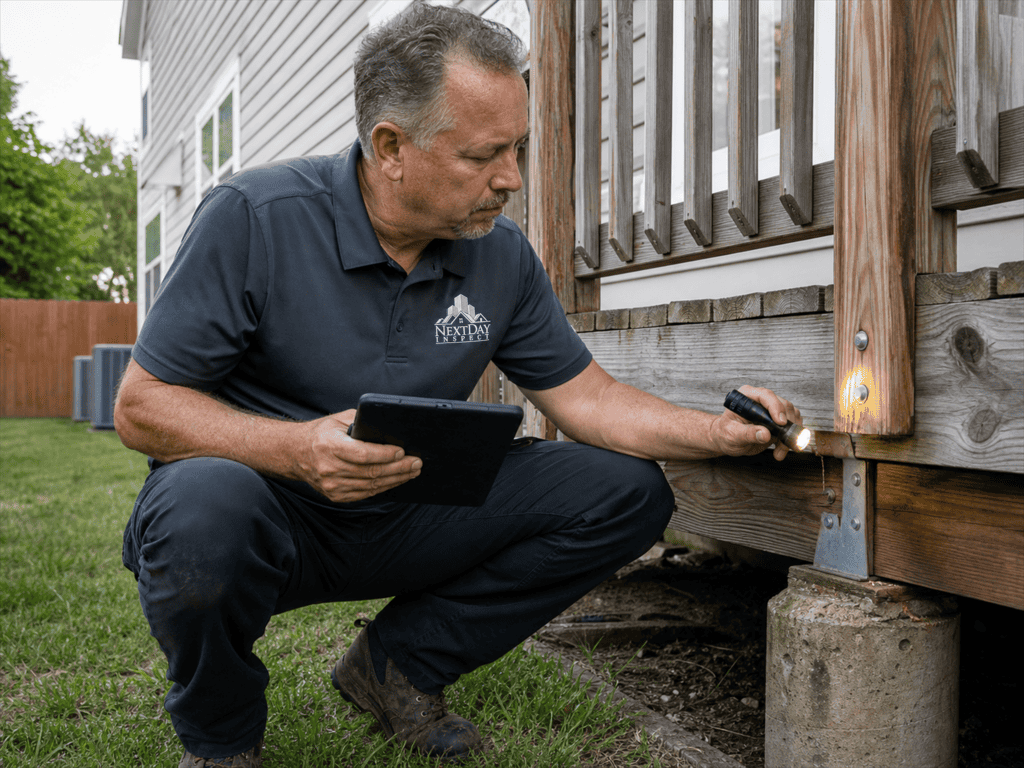
Roof, siding, grading, decks, the garage and the grounds first. The inspector photographs what they find as they go, so the report shows you exactly where each item is.

Two inspectors checking a furnace and water heater

03

Every system, run and checked

Panel cover off. Water heater, furnace and air conditioning run with their normal controls. Every fixture, every room, the attic, and the basement or crawlspace.

Inspector showing a homeowner findings on a tablet

04

The walkthrough and the report

You see the main findings in the house itself. The written report follows online with photos, priorities and what to do about each item.

On attending. You are welcome for the whole visit or just the walkthrough at the end. The walkthrough is where most questions get answered, and your agent is welcome too.

Loudoun County, east to west

Loudoun County's growth runs east to west. Subdivisions, townhouse courts and data centers spread out from the Potomac and the Dulles corridor from the 1990s onward, while Leesburg anchors an older core along Route 15. West of the Catoctin ridge the county turns rural, with larger lots and slower construction. The inspection still starts from the same basics: the house's age, its foundation type, and how it gets its water.

Aerial view of a small town center in Loudoun County with a flag-draped water tower, a church steeple and tree-lined streets, hills fading into the distance
South of Leesburg and Dulles

Cracked slabs on diabase clay

South of Leesburg and near Dulles, the county's diabase belt sits under a shrink-swell clay that expands when wet and pulls back when dry, and county records tie that movement to cracked foundations. On that ground the inspection reads foundation walls and any visible footings for stepped or diagonal cracking, checks the crawlspace for signs of shifting, and traces the grading and downspout discharge around the house before deciding whether a crack is old and stable or worth flagging as active movement. Framing at door and window openings gets a second look for square.

Did you know

Loudoun County's own geology pages describe shrink-swell clay soils above a diabase belt south of Leesburg and near Dulles that can crack a foundation as the clay expands and contracts with the seasons.

Historic streetscape in Leesburg, Virginia
North of Leesburg, Route 15

Grading over karst ground

An eighteen-thousand-acre band of karst runs east of Catoctin Mountain along the Route 15 corridor north of Leesburg, where dissolved limestone has left cavities and sinkholes under the surface. On that ground the inspection pays close attention to grading and surface drainage, looks for recent settling or depressions near the foundation, and checks the crawlspace for any sign of water finding a new path underneath the house. None of that changes how the roof, attic, electrical panel or heating and cooling equipment get checked; the same walkthrough applies everywhere in the county.

Did you know

Loudoun County government maps an 18,000-acre karst area of dissolved limestone east of Catoctin Mountain along the Route 15 corridor north of Leesburg, where underground cavities can surface as sinkholes.

What Loudoun County buyers ask us

What buyers from Sterling to Purcellville ask before they book a Loudoun County inspection.

Is there a public way to check permit history on a Loudoun County house?

Yes. LandMARC is the county's own online land management system, and its public search lets anyone look up permits, plans and land development applications by address without creating an account. It covers active and recent projects; for older paper records, Loudoun County's Building and Development office can look them up directly. A Permit History Report add-on at booking draws on these same public county records.

Leesburg and Purcellville are on my address. Does that mean I am not in Loudoun County?

You are still in the county. Leesburg and Purcellville are incorporated towns inside Loudoun County, not independent cities with their own separate government, so a house with either name on the mailing address is simply inside the county's regular service area. The same inspectors, packages and pricing apply, and there is nothing different to arrange when booking.

Is radon a concern in Loudoun County?

The EPA's original map lists Loudoun County in its moderate radon potential zone, but the Virginia Department of Health has said publicly that, based on radon results collected since that map was made, Loudoun should actually be classified high risk rather than moderate. Either way, a zone only estimates the odds for an area, not the reading inside a specific house. Radon testing can be added to the same visit as its own service and reports its own number.

What should I know about inspecting new construction in Ashburn or Brambleton?

New does not mean finished. Builder punch lists miss items regularly, and the inspection checks the same systems it would in any home: roof coverings and flashing, the electrical panel and its breakers, plumbing supply and drain lines run under real pressure, grading around a lot that may still be settling, and attic insulation and ventilation. Phased communities can also mix a finished section with an unfinished one a street over, so confirming which phase a specific address falls in is worth doing before you book.

Do I need to do anything special for a well-and-septic property west of the ridge?

Just make sure the crawlspace and any well equipment are reachable, and tell us the property is on a private system when you book. The standard inspection does not test the well or the septic system, since both fall outside a home inspection's scope; the inspector notes what is visible near the wellhead or cleanout and recommends confirming the county health department's requirements for the sale. Water testing can be added to the same visit if you want it.

Residential & Commercial

Explore Our Inspection Reports

  • HD Photography
  • Commentary & Recommendations
  • Grading Scale
  • Repair, Safety & Maintenance
View Sample Reports
Call Schedule